Thursday, 27 November 2008

#26 Widgets

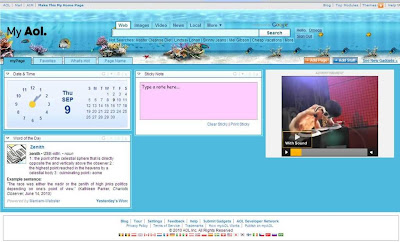
This lesson is on widgets the little gadgets that allow or open often used programs on your desktop eg little calendars, weather forecast info. This lesson features "yourminis", but in October 2008, "yourminis" decided to no longer support their startpage., making the Discovery Exercise obsolete, so I went to myAOL and iGoogle to check out their Startpage, and played with creating a page with widgets at myAOL.

I created a page and added a Word of the Day, Calendar and Clock widgets. I'm still to see if I can change colours and remove the adverts.

Thursday, 20 November 2008

#25 LetterPop

LetterPop is a collection of templates for newsletters, etc. that allows you to add your own headings and text, and photos - either from your own files or flickr. This is the free version but for serious users there's an increasing scale allowing more issues and more recipients.
While there's about 170 templates to choose from, I'd like a bit more chance to move the elements around, enlarge or decrease some. However for people who just want to produce a regular, similarly styled newsletter quickly to email to a selected list, this would be great.
My page is at
http://letterpop.com/newsletters/?id=104495-247145

Tuesday, 18 November 2008

#24 Explore.Discover.Play

Having finished my study for the year, I can now devote some time to "Learning 2.1" which is the follow-up to "Learning 2.0 - 23 things", which prompted this blog in the first place.

Learning 2.1's motto is explore...discover...play, it now has 37 things (I should have done this when I first checked as they've added 13 more things since!) or web 2.0 technologies to learn about.

The first is "Zamar" a free file conversion service. I really needed this last week when I had to convert a word file to pdf, and I like the idea of trialling converting YouTube videos to moving picture experts group file, useful for including video in PowerPoint presentations when you don't have access to the Internet, or as a Plan B if the connection won't work.


This Chaser file still looks a lot like an embedded YouTube file, but I can incorporate it in more applications.

Saturday, 1 November 2008

Serviceton Railway


The town of Serviceton (named after former Victorian Premier - Sir James Service) was gazetted on 1st January 1887. In the early years in had general stores, bakery, butcher, blacksmith, boarding houses and livery stables, temperance hotel, coffee palace and wine bar.


It became a major border crossing and an important customs station for goods passing between the colonies of South Australia and Victoria.


A Late Victorian railway station was built in 1887 of red bricks transported from Horsham. The building opened in 1889.


From the front, it had a central two storey symmetrical neo-Classical polychromatic brick station building accommodating former residential functions with flanking office wings.


The ground floor level consists of 15 main rooms, and accommodated toilets, waiting rooms, dining and sitting room, bar and kitchen, offices, lobby and customs office.


The Refreshment Room is 52 feet long with high ceilings, it is still used today for functions.


Upstairs Refreshment Manager's Bedroom

The extensive underground storage and service area was equipped with a mortuary for bodies being shipped across the border and there is a dungeon lock-up furnished with iron rings fastened to the walls, which was used for criminals captured in the disputed area or to be held over until the next train and prisoners who were being transported interstate.


The Cellar


The enormous 70-metre platform with cast iron posted verandah of standard design faces the running lines and is the largest example of its type, the platform was the longest in the State, until a portion was removed in the late 1980s.


The outbuilding/staff hostel, van goods shed, lamp room signal box goods shed and platform have all been removed.
There were two engine sheds but, with the lack of local water, the original water reservoir for the trains was constructed astride the boundary line.


The Guards Rooms

The customs office set up shop in the railway station to ensure duty was paid for goods taken interstate but the law was difficult to enforce as the town was in the 'Disputed Territory', a strip of land 4.5 km in width which stretched along the length of the state border.

The station was closed in 1986.

The Customs Store Rooms

Thursday, 30 October 2008

Arapiles


"Arapiles : selected climbs" by Simon Mentz and Glenn Tempest

The new second edition of “Selected climbs” makes the best use of publishing's capabilities.
It has natural colour photographs, many with the routes superimposed on top. The fold-out front cover has a panoramic landscape view of Arapiles and Mitre Rock and has the names the major peaks and cliffs below.
There's chapter on the history of rockclimbing at the Mount, with bios and photos of some of the pioneer climbers who have lived in Nati, or stayed at the Pines camping ground.
In total there are 1,200 selected climbs, 154 colour topos, grading and descriptions of the climbs, belay points, sun/shade icons for when in the day to go or avoid .

Wednesday, 29 October 2008

Salute to ABBA

I'm pleased to think that current technology like YouTube is being utilised to give some of the old classics a second life, so that another generation can appreciate the likes of Norman Gunston, rotary-dial phones, and Esso service stations.
">
And a hello to Claude McNicol who bought the Salute to ABBA single back in '76.

Monday, 20 October 2008

Bay of Fires


"Tasmania's Bay of Fires world's top spot: Lonely Planet"
Tasmania's Bay of Fires has been named the world's "hottest" travel destination for 2009 by international guide book Lonely Planet.
The Bay is described by Lonely Planet as "a castaway bay" with a 29 kilometres ribbon of sea and surf spooling out from the old whaling town of St Helens, on Tasmania's north-east coast.
"White beaches of hourglass-fine sand, Bombay Sapphire sea, an azure sky - and nobody," the guide says.


"This is the secret edge of Tasmania, laid out like a pirate's treasure map of perfect beach after sheltered cove, all fringed with forest.
"It's not long since the Bay of Fires came to international attention, and the crowds are bound to flock. Now is the time to visit."
The Bay of Fires tops the list ahead of the Basque country of France and Spain, Chiloe in Chile, Ko Tao in Thailand, Languedoc in France, Nam Ha in Laos, The Big Island of Hawaii, San Andres and Providencia in Colombia, Svalbard in Norway, and Yunnan in China.

Eddystone Lighthouse in background


The Bay of Fires, before this rating, had relatively little visitation compared to other Tasmanian destinations.
A four-day guided hike is considered the best way to experience its natural beauty.
From “The Age” 19Th October
(Bay of Fires just happens to be on the cover of the just released Lonely Planet guide to Tasmania)


My photos were taken of the remote northern part of the Bay of Fires at Eddystone Point. I had the beach all to myself, the nearest person would have been on a fishing trawler some distance off-shore.

Sunday, 19 October 2008

Dollars for Stick Shed

"$1.2m rescue for stick shed"
The banner headline on the front page of the local Wimmera Mail Times today.
The State Government announced today $1.2 million will be used to stabilise the Stick Shed so it could ‘vigorously pursue’ a future use for the Murtoa icon.
Work will start early 2009 on repairing the collapsed sections, securing the roof and removing the vermin.
Victorian Premier John Brumby said “This conservation program is the first step in securing the future of this incredible building which is one of Victoria’s most important and most threatened heritage places.”

Leigh Hammerton

Saturday, 18 October 2008

Raising the dead


Raising the dead : an Australian story of death and survival” by Phillip Finch.
On New Year’s Day in 2005, Australian diver Dave Shaw was halfway around the world at a steep water-filled crater in the Kalahari Desert. His destination was nearly 900’ or over 270 meters below the surface.
Wearing some of the most advanced diving equipment Shaw descended Bushman’s Hole, just below the surface was a narrow fissure, he slipped through the opening and disappeared from sight into a huge deep cavern.
Minutes later a second diver descended through the same crack in the stone. Don Shirley, Shaw’s friend and frequent dive partner was a master among the community of cave diving.
25 minutes later one of the men was dead, and the other in mortal peril, facing a struggle to survive for the next ten hours, existing literally from breath to breath.
The organised expedition was to raise the body of Deon Dreyer who had died in Bushman’s in 1994. Shaw had discovered the body on a dive in 2004 when he was setting a depth world record, but was unable to lift the body from the floor of the cave.
He returned early in 2005 with a team of support divers, mining and police rescue teams, and heaps of equipment including a mobile recompression chamber and nearly 100 breathing cylinders.
The book covers Don’s early life in Australia, his work as a pilot for the airline Cathay Pacific, and his interest in diving, in particular in the rebreather technology and deep diving. The story moves forwards and backwards several times, and though you know generally what will happen, it still grips you.
“Raising the dead” is about the perilous sport of deep and cave diving – its history, its culture and the individuals who pursue it.
I read nearly half of the book (145 of the 305 pages) in one sitting, and then kept thinking about it long afterwards. Things like: this dive was about Dave’s 330th dive; the families; getting ‘bent’ with an inner ear injury; and Dave’s choice of music – there’s an appendix at the back of the book with his iPod playlists, I think it says a lot about the guy.
(The photos are mine taken with a disposable camera on the surface at Vaikona Chasm, definitely not in the same league)