Showing posts with label Libraries. Show all posts

Sunday, 12 March 2023

Wednesday, 14 February 2018

The sounds of the ABC


 A sign of the times? 

The ABC has made the decision to close its libraries in Adelaide, Hobart and Perth.

Background article from 'The Guardian' on the ABC's decision to axe its Sound Library and make its ten specialist Librarians redundant.


Quotable quotes:

  • The ABC is dismantling its historic sound and reference libraries (which are packed full of 100,000 CDs and 373,000 vinyl as well as books and journals after 85 years of collecting) across the country and making 10 specialist librarians redundant to free up floor space and save on wages.
  • Library sources say they believe between 5% and10 % of the collection will be digitised into the Broadcast Music Bank.
  • ABC Broadcaster Lucky Oceans stated “The theory behind it is that people aren’t using hard copies and that it’s all digitised. But you know it’s those same people who were saying that vinyl is dead."
  • The extensive collections in Adelaide and Sydney would all but disappear, along with all the skill and knowledge of the library staff to “better align our operations with the ABC’s strategic aims”.
 

And in art imitating life or life imitating art a Radio National article on cuts to Trove.

Monday, 25 September 2017

Intellectual secrets

I was sent a link to an article by James Somers titled 'Keepers of the secrets' which relates to his experience when visiting the archives division of the New York Public Library.


The most quotable quote from the article has to be - 

"The real work, though, in processing a collection, is intellectual. The goal is to make the files you’ve received findable"
In an age when people say Google has all the answers to your information questions, and when economic rationalists question the value of extra time and effort expended on a bibliographic record, this is a refreshing affirmation.
Go James!
James Somers is a writer and programmer based in New York.

Monday, 6 February 2017

Buying a book

Twisted Sifter has a number of photographs of the beautiful Buenos Aires ‘El Ateno Grand Splendid’ bookshop inside a 100-year-old theatre. 

Situated at 1860 Santa Fe Avenue in Barrio Norte, Buenos Aires, you will find one of the most stunning bookstores in the world. El Ateneo Grand Splendid is one of the best known bookshops in Argentina. 

Designed by the architects Peró and Torres Armengol, with ceiling frescoes painted by Nazareno Orlandi and support columns sculpted by Troiano Troiani, the grand theatre first opened in May 1919 with a seating capacity of 1,050. In the late 1920s it was converted into a movie theatre, and then retrofitted into a flagship bookshop during 2000.

According to a recent study by the World Cities Culture Forum, Buenos Aires has more bookshops per inhabitant than any other city in the world – roughly 1 bookshop per 3,937 inhabitants (Melbourne is well back at 1 per 12,945. It does fare better with the number of public libraries – Buenos Aires has one library for 35,680 inhabitants, while Melbourne has one for every 29,213 – so maybe Melbournians just prefer to borrow rather than buy!).

Friday, 25 September 2015

Lighthouses and libraries


Hornby
Scanning the scholarly Library Journal - as you should - and was struck by the article "The history of lighthouses" by Alex Byrne in the special 50:50 by 2020 issue.
Alex uses the analogy that libraries like lighthouses have an equally long and important history, and reveals the similarities.
As lighthouses shifted from manned to automated (Maatsuyker Island was the last in 1995), so too libraries have moved from print to electronic.
Alex finishes with "Libraries & librarians will continue to respond to their communities, subtly, continually and sometimes dramatically re-imagining their services. (true enough) We continue to be beacons of knowledge, but, unlike lighthouses, we will not become silent outposts of technology blinking hopefully out to sea."
Macquarie

Barrenjoey
I take some umbrage on behalf of the silent outposts - they will come into their own when an EMP burst takes out all the satellite guidance GPSs and we welcome trusty old clockwork.
Maybe like lighthouses libraries are solidly built to withstand all that can be thrown at it, and to see us through the passage of time.
Alex included a fact I didn't know - lighthouses are covered in the Australian Constitution 'the Commonwealth has the power to make laws for the peace, order and good government with respect to lighthouses', transferring them from the states.
I've included a number photos of the classic-style Sydney lighthouses (Alex is the NSW State Librarian).

Saturday, 8 March 2014

Once upon a children's book

The 'Once upon a time: a world of children’s picture book art' exhibition opens on Friday 21st March and runs till Sunday 31st August, in the Cowen Gallery of the State Library of Victoria in Swanston Street Melbourne.
from 'The hidden forest' by Jeannie Baker
May Gibbs' gumnut babies
Let your imagination run wild in this free exhibition celebrating the world of children’s picture book art. See classic characters like Blinky Bill and the Magic Pudding, as well as fun favourites including Miffy, Grandma Poss and Old Tom. You’ll also see aliens and fairies, tigers and bears, cranky cats, playful pups and a dinosaur who does the dishes!
 Look at original drawings, dummy books and videos about the artworks to discover the magic behind creating illustrated stories, then create your own story with our free activity booklet.
The State Library is now the custodian of Dromkeen Children’s Literature Collection which was previously at the Oldmeadows’Dromkeen Homestead at Riddells Creek. 
The collection consists of approximately 7500 original artworks and illustrations from prepublication material of many of Australia’s best-loved children’s books. The collection also includes a historical book collection, six bronze sculptures of picture book characters and the Dromkeen archive.
The prepublication artworks include early drafts of classics like Ron Brooks’ “John Brown, Rose and the Midnight cat”, before John Brown became an Old English sheepdog.
There are the rare copies of stories, such as the original “The Bunyip of Berkeley’s Creek” by Jenny Wagner, the story and illustrations had successfully passed through all the editing and publishing stages when a young child pointed out that the male wallaby had a young joey in a pouch. Successive editions changed the ‘his’ to a ‘her’!
The original 'Bunyip of Berkeleys Creek'
With the State Library, the Dromkeen Collection continues to foster a love of books & reading, and to support literacy among young people.

Monday, 24 February 2014

The Top Ten books

The Sydney Morning Herald headline trumpets “Library book borrowers stay true to their favourite authors, survey reveals”

The survey comes from Public Lending Right and Education Lending Rights scheme, which make payments to authors and publishers based on the estimated numbers of books held in the collection of lending libraries.
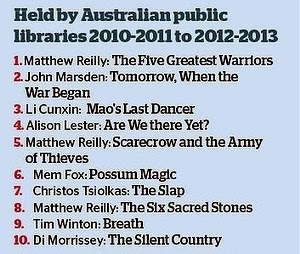
The figures show Matthew Reilly's The Five Greatest Warriors was the most in-demand home-grown title held by Australian public libraries in the past three years - one of three Reilly titles that made the top 10 - with more copies of the Indiana Jones-style series on library shelves than any other books.


John Marsden's dystopian Tomorrow, When the War Began and Li Cunxin's autobiography Mao's Last Dancer followed.
In school libraries, it was Mem Fox's evergreen Possum Magic that dominated bookshelves in 2012-13, followed by Emily Rodda's Rowan of Rin and Marcia Vaughan's Wombat Stew.
The tables are created by the Public Lending Right and Education Lending Rights scheme, which aims to compensate for the creators' loss of potential sales from loans in libraries. In the old horror days library staff had to spend days pouring over lists and card catalogues gathering the data, but thanks to leaps in technology, now a machine can do it in a fraction of the time.
Almost $20 million was distributed for the last financial year. To be eligible, libraries must stock a minimum of 50 copies of the same title and payments based on copies held. The charts suggest the enduring value of Australian children's literature as new generations continuing to rediscover old favourites.
Borrowers preferred popular fiction over literary titles and, once they discovered an author they liked, they kept returning to the backlist over and over again.
Christos Tsiolkas' The Slap was the most widely held work of Australian literary fiction over the past three years along with Tim Winton's Breath, just ahead of Di Morrissey's The Silent Country.
Morrissey had three books in the top 30. The late Bryce Courtenay had four titles in the top 30 while Geraldine Brooks had two.
It is interesting to compare the Australian list with the British list (above) – I think we have a better selection Come on Aussie.

Wednesday, 30 October 2013

Haunting the halls

Just in time for Halloween comes an article from ALIA on the five most haunted libraries
Number one is the Marsh's Library in Dublin, Ireland, it was founded in 1701 by Archbishop Narcissus Marsh. Marsh's Library was actually the first Public Library in Ireland.
Many have reported seeing the creator of the Library, Marsh himself roaming around the library. He is known to like moving the books around and then the next day it's all back in order. He has somewhat of a sense of humour it seems. Some also say that he is searching for a letter and that is why he still roams but he could also be a nosy ghost and making sure his library is in good condition.
The entrance to Marsh's Library
The Templo de la Compania de Jesus, Morelia
Second is the Morelia Public Library in Michoacan, Mexico is known for it's history, beauty, and ghosts! The library dates back from the 17th century when it was built as a church for the adjoining Palacio Clavijero, and known as the Temple of the Company of Jesus. In 1930 after being used for many functions it was made into a library.
According to reports a nun dressed in blue that dates back from the 16th century has been haunting the library for many years. Also even members of the library have said that they get a paralysed feeling and they felt like a strange unknown presence was around them.
At number 3 is Rammerscales House is located in Dumfries in Scotland. It's a 18th century Georgian house that has an impressive library with Jacobite relics, books, and 20th century paintings, sculptures, and tapestries.But this 18th century home didn't lose it's former owner, James Mounsey who likes to spend his time in the library. He must be a frightening ghost because legend has it that two people in World War II were spending a night in Rammerscales and were so frightened by the ghost of Mounsey that they decided to sleep in the stables.
Rammerscales
Fourth is our own State Library of Victoria in Melbourne. The library established in 1854, holds over 2 million books, it has historical diaries, the armor of Ned Kelly, and impressive history but it has it's ghosts too! One ghost in particular is a deceased librarian who likes to hang out in the child's books. Maybe she remembers reading to the child. Another ghost is an unknown gentleman who likes to roam the library halls. Security guards have seen strange things on the stairs like glowing balls.
The State Library at night - spookier
And finally at 5 is The British Library the national library of the United Kingdom and it has wide range of things for any researcher out there. It indeed seems to a very impressive place and a must-see place for any librarian fanatic before they depart. Speaking of departing some don't ever want to depart of the place but do we really blame them? According to the Sunday Times, in an 1996 article they reported of workmen who were remodeling the library said that they saw a man in 18th century clothing weeping. Not sure why the ghostly man was weeping but maybe he didn't much care for the changes. All joking aside it is a known fact that ghosts don't like change and that's when a lot of activity starts happening when someone is remodeling a home or a public building.
The modern facade of the British Library


Wednesday, 29 May 2013

Stone the crows

In his memoir 'Life' Keith Richards admitted that he once considered becoming a librarian before the birth of The Stones, and recently he'd sought professional training in the Dewey Decimal Classification System to manage his large personal library (apparently he was painstakingly arranging his vast rare book collections of  early American rock and World War II histories via Dewey - but then doesn't everyone?!) Try to reconcile the hell-raising rock guitarist famous for his life of sex, drugs and rock n roll with that of an avid bookworm! 
And in a quotation featured on many library websites, Keith is reported to have said: “When you are growing up, there are two institutional places that affect you most powerfully: the church, which belongs to God, and the public library, which belongs to you. The public library is a great equalizer.”


In his book, Keith Richards, one of the Rolling Stones' founding members,opens up about his childhood, rise to super-stardom, and personal life. From his turbulent relationships, including his well-publicised estrangement from, and reconciliation with Stones' front man Mick Jagger to his drug shenanigans that made even more of a legend amongst his fans. With the Rolling Stones, Keith created the guitar riffs, the lyrics and the songs that roused the world, and over four decades he lived the original rock and roll life: taking chances, speaking his mind, and making it all work in a way that no one before him had ever done. Richards tells all in this poignant biography.

Monday, 31 December 2012

The film, the book, the app


I want need an iPad, ‘cos…
It’s not often that a film precedes a book, but it happened with the Academy Award winning animated short film for all bibliophiles – ‘The fantastic flying books of Mr Morris Lessmore’. The story follows reader and writer Morris Lessmore and his custodianship of a magical library of flying books. It was created using miniatures, computer CG & stop-motion animation, and traditional hand-drawn techniques.

Wonderful quirky work with books
 I first saw this on YouTube, and now the actual book has been published as a hardcover children’s picture book ‘The fantastic flying books of Mr Morris Lessmore’ by William Joyce.


There is also an iTunes app by Moonbot Studios (Moonbot is the storytelling and animation collective co-founded by Joyce) to accompany the book/film, which as iTunes states “blurs the line between picture books and animated film”.
From the app which lets you draw, play piano & more
 ‘The fantastic flying books of Morris Lessmore’ is a story of people who devote their lives to books and books who return the favour. Morris Lessmore is a poignant, humorous allegory about the curative power of stories and how they can positively affect our lives.

The real book
William Joyce began working on the story in 1999, as a tribute to the late Bill Morris the soft-spoken, dry-witted pioneer of library promotions. The hurricane Katrina devastated Joyce’s home state and interrupted the story’s progress. Joyce saw firsthand the curative power of stories when he visited displaced children reading donated books in the shelters.

Setting the scene - stop-motion miniature
And even better, the story has also been released as an augmented reality app by Moonbot Studios, the IMAG•N•O•TRON, which brings the pages of the book to life!

It starts with a real or digital book! Once you have your copy of ‘The fantastic flying books of Mr. Morris Lessmore’,  users can view the picture book through the IMAG•N•O•TRON app using an iPad 2/3 or iPhone 4+ camera, you get swept up in a storm, Humpty Dumpty befriends you and you get a sneak peek into a part of Lessmore’s world not shown in the book or movie.  Check it out on this Vimeo video -


See the IMAG•N•O•TRON in action! from Moonbot Studios on Vimeo.

To download the IMAG•N•O•TRON app

Integrating such innovative and exciting technology with books is awesome and awe-inspiring – what's next?
I believe it says something profound that a short film and app are about the preciousness of the paper book.

Wednesday, 31 October 2012

Book + child = Love


 'The lonely book' by Kate Bernheimer and illustrated by Chris Sheban.
Once there was a brand-new book that arrived at the library. The book loved to be read and it was popular with many children who would check it out (and it hardly ever slept at the library), then it time it becomes old and worn and the increasingly shabby library book grows lonely until, that is, Alice a young girl rediscovers it and doesn't mind that its old and missing the last page ("This is the most beautiful book I've ever read", so she put back 3 new books so she was able to take the lonely book home instead). It is the enchanting story she loves and she always imagined a happy ending on the missing last page. Alice reads the book every night and takes it to show-and-tell - the book had never felt so beloved. But disaster strikes when a library volunteer thinks the book is meant for the Book Sale, and the book enters its loneliest period in the basement. At the Book Sale Alice re-discovers the book and it goes back to her bedroom,where the book knows its always-and-forever home.
This is one of those cross-over books  - the size and dimensions of a picture book with the text and complexity of junior fiction, and beautifully illustrated by Chris Sheban.
The moral of the story -

  • its not just the new books which need to be borrowed
  • be very careful when weeding - don't judge the book by its cover
  • children can still have a meaningful and loving relationship with a real book
  • Wednesday, 18 April 2012

    Walking off the page

    Planning for ALIA's Library & Information Week (21-27 May).
    This year's theme is 'Think outside the book', and this post from WebUrbanist does that Gripping Book Art: 31 sculptures worth reading about 
    Here are some of the illustrations. 


    Thursday, 25 August 2011

    The art of the library


    Sometimes I find it regrettable that Australia does not have centuries old buildings - castles, monasteries...libraries. While there are still beautiful Georgian buildings dating from late 18th century there isn't the art and the history.
    Still there is Bountiful Books: 13 Incredibly Intricate Historic Libraries: Dark wood, dazzling details, leaded glass windows and tier after towering tier of books – classic historic libraries are a bibliophile’s dream. These libraries, dating from the 18th to the early 20th centuries, represent some of the most astonishingly beautiful book repositories ever built.

    Trinity College Library, Dublin, Ireland
    At Ireland’s oldest university Trinity College, home to the "Book of Kells", the ‘Old Library’ with its Long Room >> stuns with its dark wood, spiral staircases and seemingly endless aisles of books.
    It was built between 1712 and 1732 and renovated in 1860 to include a barrel ceiling for a second floor of book shelves.
    The largest library in Ireland, it has 5 million printed volumes with extensive collections of journals, manuscripts, maps and music.

    Iowa State Capitol Law Library
    Hogwarts immediately comes to mind with these photos.
    A lacy white banister flows along tier after tier of books and down a beautiful spiral staircase at the Iowa State Capitol Law Library, located in the Capitol building.
    The library provides Iowa lawmakers, lawyers, government employees and the public with a specialised legal collection of treatises and law books.
    More libraries are featured at WebUrbanist

    Tuesday, 4 May 2010

    Not in the news

    Library cut hits local history
    "It is terrible to hear from former professor Wallace Kirsop, convener of the State Library of Victoria Users Group, that the federal government is withdrawing funding for the digitisation of newspapers. This will mean that the newspapers of Australia's country towns will not be digitised.
    These papers are frequently the only sources of historical information for the past 200 years on such towns. They are valuable resources for family historians too, many of whom use the State Library.
    Minister Peter Garrett should reinstate the funding for this most valuable cultural work immediately. I hope Prime Minister Kevin Rudd will intervene to stop this cultural vandalism.
    Of course, Arts Minister Peter Batchelor could come up with the money for Victorian country newspapers. Perhaps he might inform your readers and the users of the State Library exactly what amount of money is spent on book and other acquisitions for the library. Wallace Kirsop, three State Library of Victoria staff and I could not find it.
    It seems to be a pittance of about $2 million. By contrast, the University of Melbourne has a library acquisition budget of more than $20 million."
    by Paul Knobel, convener, State Library of NSW Constant Users Group, Randwick, NSW
    From The Age Letters 27.4.2010


    No other details available at this stage, don’t know how or if this will affect the State Library’s “Digitising Victorian Newspapers Project” and our hopes for the Horsham Times/Wimmera Mail Times.

    Sunday, 24 January 2010

    Downsized


    Westbury-sub-Mendip a small village in Somerset, England has opened the reputedly smallest library in the world.
    A resident dreamed up the idea when the village lost its phone box and mobile library in rapid succession.
    The old bright red telephone booth was purchased for one English pound and remodelled as a book exchange - the smallest library in the world.


    The library (booth) holds a collection of over 100 books and a variety of movies and music CDs.

    No mention of attendant library staff - must be an honour system. Villagers can use the library around the clock.


    Residents line up to swap their books (not much chance of more than one checking out the shelves at a time) with new ones left by other patrons.

    If only this phone box were a TARDIS having enough space would not be an issue.

    Friday, 28 December 2007

    Still in Detroit

    People have been calling Detroit "the motor city" or "Motown" for years, as along with Henry Ford most car companies were based there - Ford, Studebaker Packard Motors, Fisher Body Plant, Uniroyal Tire Plant, Chrysler's Dodge Main complex, & General Motors Cadillac Plant. Now after its heyday these buildings are abandoned, taken-over or demolished.
    The remains of Henry Ford's Model T Automobile Plant. Built in 1909, it once produced 1000 "Tin Lizzies" a day. In its last days of vehicle manufacturing, it produced Ford tractors. It ceased production in the 1970's, and is now a shopping mall.

    The immensity of the Packard Motors ruin site defies photography. This panoramic image shows only about twenty per cent of the site, from across one of the huge parking lots that was once filled by cars of its employees. Partially torn down in 2000, a law suit has held up its full demolition.

    It wasn't just the manufacturing industry that suffered in Detroit.
    The lavish Michigan Theater, capable of seating 4050 people. The demise of this once mighty movie theater arose, in large part, from its inability to compete with the newly emerging suburban movie theaters and their acres of free parking. So now its auditorium is itself a carpark.

    Even the humble library building succumb...


    The Magnus Butzel Branch Library (demolished May 1998) serviced a bygone neighbourhood in an area of Detroit known as Poletown after the Polish immigrants who populated it and supplied the labour for the Dodge company.


    The collapsing six story section of the J. L. Hudson Department store during its 1998 implosion.