Tuesday, 1 April 2014

Wow weekend

On the weekend, I had a chance to tick a couple of boxes
Kattemingga's church
I'd come across a Pinterest photo of 'Old church in fog, Kattemingga, Victoria, Australia', was intrigued didn't know Kattemingga - so Internet search = it is in central Victoria just south of Newbury. 
The grounds of Kattemingga Lodge
Kattemingga Lodge is a 150 acre farm, with a accommodation, AND a film-set used for 'The Man from Snowy River', 'Ponderosa', 'The Mole', and a number of commercials - I had to visit!
The farm/lodge is currently operated by Nola & Gary Whitehouse and who have been there for 35 years, but as Nola is about to turn 72, they have decided to retire, having sold the property to a Buddhist retreat, so the future of the film-set buildings is uncertain (and my recording of them imperative).
The main street of the film-set
With all the planning of a military campaign, I stayed Friday night at the Lodge overlooking this - 

Then up before the crack of dawn

And cycle off to take lots of photos


The buildings are falling into decline, but were constructed as complete structures, not just facades, with the interiors also being used for shooting


The Hotel being a bit more up-market than the saloon, and still with a couple of props on location.


  I whiled away some hours wandering around and through the set, then took off to satisfy yearns for caches, bridges, cemeteries...more on that next post.


Tuesday, 25 March 2014

Audio noise


Listening to the last disc of Patrick Ness' 'The knife of letting go'. I was given this copy some time ago with the recommendation that it was a great story, wonderfully wrought in audio by Humphrey Bower. I put it away thinking I'd get to it at a suitable time. Well the time has come, and I'm playing it in the car. Now the true test would you stay in the car listening to a book after you've arrived at your destination? Yes I did.
The story is a teenage science fiction story set on New World.
Todd Hewitt is the last boy in Prentisstown. But Prentisstown isn't like other towns. Everyone can hear everyone else's thoughts in a constant, overwhelming, never-ending Noise. There is no privacy. There are no secrets. Or are there?
Just one month away from his 13th birthday - the birthday that will make him a man, Todd unexpectedly stumbles upon a spot of complete silence. Which is impossible. Prentisstown has been lying to him. And now he's going to have to run... 

It is the first book of the 'Chaos Walking Trilogy', so would I read/listen to the rest? You bet! 
The trilogy's film rights have been bought by Lionsgate, so if depicting Noise was an art for the audio version, it will be interesting to see how it is portrayed on the big screen.

Sunday, 9 March 2014

Ghost island

Have to make mention of this again after Prime screened "Ghost island" last night. The segment was on the same island as my Ultimate assignment post Hashima or Gunkanjima (Battleship Island).
Gunkanjima in battleship silhouette
When you put aside their over the top hype -  "This tiny island was once the most crowded place on the planet, until suddenly in 1974 every inhabitant disappeared..." it goes on to explain "For the past 30 years, Hashima Island, off Japan’s south coast, has been off limits, with public denied access to any part except the landing stage. Little bigger than the MCG, this mysterious place was home to more than 5,000 coal miners and their families for over 80 years. They were well paid, every square metre of the island filled with towering apartment blocks. This speck in the South China Sea was the home to doctors, teachers and shopkeepers – then it was abandoned.
Closed to the outside world for decades, the island is a snapshot in time; everything is as it was when the last boat left. Two years ago part of the island was used for the James Bond movie Skyfall, and now Sunday Night reporter PJ Madam has been given exclusive access to all parts of this island of ghosts. The vision captured is eerie, captivating and extraordinary."
Here is the link to the Prime story
And yes I'd go if it was for access to all of the island like the film crew and not just the tourist version.

Saturday, 8 March 2014

Once upon a children's book

The 'Once upon a time: a world of children’s picture book art' exhibition opens on Friday 21st March and runs till Sunday 31st August, in the Cowen Gallery of the State Library of Victoria in Swanston Street Melbourne.
from 'The hidden forest' by Jeannie Baker
May Gibbs' gumnut babies
Let your imagination run wild in this free exhibition celebrating the world of children’s picture book art. See classic characters like Blinky Bill and the Magic Pudding, as well as fun favourites including Miffy, Grandma Poss and Old Tom. You’ll also see aliens and fairies, tigers and bears, cranky cats, playful pups and a dinosaur who does the dishes!
 Look at original drawings, dummy books and videos about the artworks to discover the magic behind creating illustrated stories, then create your own story with our free activity booklet.
The State Library is now the custodian of Dromkeen Children’s Literature Collection which was previously at the Oldmeadows’Dromkeen Homestead at Riddells Creek. 
The collection consists of approximately 7500 original artworks and illustrations from prepublication material of many of Australia’s best-loved children’s books. The collection also includes a historical book collection, six bronze sculptures of picture book characters and the Dromkeen archive.
The prepublication artworks include early drafts of classics like Ron Brooks’ “John Brown, Rose and the Midnight cat”, before John Brown became an Old English sheepdog.
There are the rare copies of stories, such as the original “The Bunyip of Berkeley’s Creek” by Jenny Wagner, the story and illustrations had successfully passed through all the editing and publishing stages when a young child pointed out that the male wallaby had a young joey in a pouch. Successive editions changed the ‘his’ to a ‘her’!
The original 'Bunyip of Berkeleys Creek'
With the State Library, the Dromkeen Collection continues to foster a love of books & reading, and to support literacy among young people.

Wednesday, 5 March 2014

Growing cities

Must be time to combine a WebUrbanist post and 'Now & Then' images. I had seen some of these photos before, but hadn't recorded it, now here are just some of the more dramatic examples from "Then & Now: the stunning speed of urban development"
We complain about the pace of change, as old buildings are ripped down to be replaced by often uglier, utilitarian replacements. That pales against the mammoth pace of change in some overseas cities.

The well-known gambling mecca of Las Vegas was carved out of the Nevada desert, when hotels and casinos began construction in the 1930s.

The top black & white photo with the early hotels the Dunes and the Flamingo, is from 1954, and the colour image is from 2009.


China is in a building boom at present, and this is evident from these two photographs of Shanghai. The daylight image was taken in 1990, and the night-time image just 20 years later in 2010.

 Dubai may be where all the oil money is, and it shows in the architecture. 
You can recognise the 3-part apartment building in both photos, but everything else appears to have changed from 1990 to 2003. And it will have changed again in the past 10 years.

You knew Tokyo would make the list - on the left is the Japanese city in the 1960s and again on the right in 2010.
Finally - Panama City is one of the fastest growing urban areas in the world, and these two photographs illustrate the sharp contrast between the two eras. The black & white town sprouts into a maze of skyscrapers between 1930 and 2009.
 Check out other famous cities London, Paris... on the WebUrbanist post.

Monday, 24 February 2014

The Top Ten books

The Sydney Morning Herald headline trumpets “Library book borrowers stay true to their favourite authors, survey reveals”

The survey comes from Public Lending Right and Education Lending Rights scheme, which make payments to authors and publishers based on the estimated numbers of books held in the collection of lending libraries.
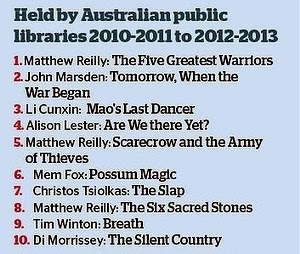
The figures show Matthew Reilly's The Five Greatest Warriors was the most in-demand home-grown title held by Australian public libraries in the past three years - one of three Reilly titles that made the top 10 - with more copies of the Indiana Jones-style series on library shelves than any other books.


John Marsden's dystopian Tomorrow, When the War Began and Li Cunxin's autobiography Mao's Last Dancer followed.
In school libraries, it was Mem Fox's evergreen Possum Magic that dominated bookshelves in 2012-13, followed by Emily Rodda's Rowan of Rin and Marcia Vaughan's Wombat Stew.
The tables are created by the Public Lending Right and Education Lending Rights scheme, which aims to compensate for the creators' loss of potential sales from loans in libraries. In the old horror days library staff had to spend days pouring over lists and card catalogues gathering the data, but thanks to leaps in technology, now a machine can do it in a fraction of the time.
Almost $20 million was distributed for the last financial year. To be eligible, libraries must stock a minimum of 50 copies of the same title and payments based on copies held. The charts suggest the enduring value of Australian children's literature as new generations continuing to rediscover old favourites.
Borrowers preferred popular fiction over literary titles and, once they discovered an author they liked, they kept returning to the backlist over and over again.
Christos Tsiolkas' The Slap was the most widely held work of Australian literary fiction over the past three years along with Tim Winton's Breath, just ahead of Di Morrissey's The Silent Country.
Morrissey had three books in the top 30. The late Bryce Courtenay had four titles in the top 30 while Geraldine Brooks had two.
It is interesting to compare the Australian list with the British list (above) – I think we have a better selection Come on Aussie.

Saturday, 15 February 2014

Out on a limb

Yes, I was one of the 8 million...
Vitaliy on the crane boom
Vadim Makhorov and Vitaliy Raskalov have gained a lot of notoriety with their video this week (posted yesterday on Twisted Sifter).
The video, released on Wednesday February 12, 2014, has already been viewed over 8 million times, in just 2 days. 
The ethereal glow on the low cloud
Vitaliy on the 100th floor
The Two Towers - JinMao Tower (421m) & Shanghai Financial Centre (490m)
The GoPro video shows the duo (who together are OnTheRoofs), climbing the still under-construction Shanghai Tower. Upon its completion in 2014, it will stand approximately 632 metres (2,073 ft) high and will have 121 storeys. Following its topping out on 3 August 2013, it became the tallest building in China and the second-tallest in the world, surpassed only by the Burj Khalifa in the United Arab Emirates.
Vitaliy's feet adding a sense of perceptive
Vadim photographing 'The Bottle Opener' the Shanghai Financial Centre
Looking down the core of the Shanghai Tower

Raskalov says the pair had planned to start their ascent on January 31st, which not coincidentally was the first day of China’s Lunar New Year, a major holiday in China, while the workers were celebrating at home, and the security was less watchful. 

It took them about two hours to get to the 120th floor by foot. At midnight they arrived above the clouds at the roof-top crane. They spent an additional 18 hours on top of the building sleeping and waiting for the cloud to clear. 

From the crane jib
Cloud beginning to wrap round the towers
Vadim on the tip of the crane
While the video documents their ascent, both are keen photographers and took the time to capture some amazing shots of the bustling metropolis below. 

To see the rest, visit their blogs Vadim's and Vitaliy's (the text is in Russian & English).

Needless to say what they did was illegal and dangerous. Even though they said there was little wind, you could still hear it whistling across the camera mic.

Personally I am content to just enjoy the photographs & video - maybe not with my heart in my mouth, but it might be scaling up my throat!

Friday, 14 February 2014

500 not out

The image says it all -

this is Bibliophile's 500th post.

From the first tentative entry in October 2007, we've been all over the planet, gone back in time, and seen this blog morph into an eclectic collection of posts.
  • The most popular story over this time is 'Shipwrecks & sea disasters' with 10,177 views (and counting)
  • Americans (the U.S.) are the most interested audience at 29,302 beating the Australians at 13,193
  • The most used Label belongs to my 'Diary' posts (113), followed by 'Abandoned' (91) occurrences
To all those viewers out there - Thanks for the memories and keep on visiting.

Wednesday, 12 February 2014

Diving the depths of a great cathedral

Just like a Dan Brown thriller only true! The vast, splendid Hagia Sophia (which has featured in a couple of Dan’s novels), which is now a museum, sits atop an ancient series of underground tunnels said to connect the cathedral with the Basilica Cistern Princes’ Islands and the Topkapi Palace. Director Göksel Gülensoy has enjoyed a long-standing love of the Hagia Sophia, and decided to embark on a scuba diving expedition under the building to unlock some of her ancient secrets.
The vast interior of Hagia Sophia
His 50-minute film, “In the Depths of Hagia Sophia” (Link to film trailers) shows a side of the historic structure that has never before been explored in depth, let alone filmed. Along with two divers and four spelunkers, he delved into the mysterious depths to see what, exactly, Hagia Sophia was hiding.
Squeezing into the bowels of the cistern
The team began by opening the reservoir doors in the main hall; the two doors had both been shut for quite some time, and never before had a diver been allowed into the reservoir. After studying the small first chamber, the team moved on to the larger second reservoir. There they found flasks thought to have been left behind by British soldiers in 1917, a chain which may have contained a prisoner at one time, and various other bits and pieces of the cathedral. They then moved into the two passageways beneath the huge cathedral, finding sealed passages, a graveyard full of children’s bones, and the burial chamber of Hagia Sophia’s first priest. They found that the passages long thought to lead to the Basilica Cistern and Princes’ Islands were non-existent. Every person who dove beneath Hagia Sophia that day underwent a full-body X-ray to prove that no artifacts had been removed from the site.
Hagia Sophia in Istanbul
This would be a great premise for a new Matthew Reilly Scarecrow or Ascham adventure.