I have just changed this blog's template. For those readers who use a
mobile phone device to access these posts, it should now fit into an
appropriate screen layout instead of the old desktop style.
If you wish to see or access the links in the Sidebar, just use the View web version option at the bottom of the posts.
For those who view it via a PC, it will still appear in the desktop version.
What do you think??
Wednesday, 18 January 2012
Wednesday, 11 January 2012
And isn't that the truth
This is the ongoing balancing act - bestseller versus classic literature - which, how much, and how quickly.
Thursday, 15 December 2011
Humour with a capital letter
"Going Postal" is the story of arch-swindler Moist Von Lipwig (Richard
Coyle) and the beautiful, vengeful Adora Belle Dearheart (Claire Foy). It has been made into a movie, which is screening on ABC1 TV on Saturday 17th at 7:30pm.
A life-long travelling con-artist & fraud, Lipwig's crimes finally catch up with
him in the city of Ankh-Morpork. Faced with death by hanging, Lipwig is
spared by Lord Vetinari (Charles Dance), who sees him as the perfect
man for the role of Postmaster in the decrepit Ankh-Morpork postal service.
Faced with an almost impossible task, and making an immediate enemy of bloodthirsty tyrant Reacher Gilt (David Suchet), owner of the rival money-hungry Grand Trunk Semaphore Company's clacks communication monopoly, Lipwig's first instinct is to run. That is until he meets the spellbinding Adora. Captivated by her beauty and her brains, Lipwig will try anything to win her affections... little knowing the part he has played in her family's downfall.
Lipwig has got to see that the mail gets through, come rain, hail, sleet, dogs, the Post Office Workers' Friendly & Benevolent Co., or a midnight killer. Maybe it'll take a criminal to succeed where honest men have failed, or perhaps there's a shot of redemption in the mad world of the mail, waiting for a man who's prepared to push the envelope...
Sir Terry Pratchett is the second most-read author in Britain today, behind J.K. Rowling. His back catalogue, is the number one best selling of any author in the U.K. Pratchett is increasingly popular in the United States and is now the sixth most read non U.S.-author in the United States.
Full of the jokes, parodies, allusions and references which season the Discworld stories, you need to see "Going postal".
![]() |
| From the film version |
Faced with an almost impossible task, and making an immediate enemy of bloodthirsty tyrant Reacher Gilt (David Suchet), owner of the rival money-hungry Grand Trunk Semaphore Company's clacks communication monopoly, Lipwig's first instinct is to run. That is until he meets the spellbinding Adora. Captivated by her beauty and her brains, Lipwig will try anything to win her affections... little knowing the part he has played in her family's downfall.
Lipwig has got to see that the mail gets through, come rain, hail, sleet, dogs, the Post Office Workers' Friendly & Benevolent Co., or a midnight killer. Maybe it'll take a criminal to succeed where honest men have failed, or perhaps there's a shot of redemption in the mad world of the mail, waiting for a man who's prepared to push the envelope...
Sir Terry Pratchett is the second most-read author in Britain today, behind J.K. Rowling. His back catalogue, is the number one best selling of any author in the U.K. Pratchett is increasingly popular in the United States and is now the sixth most read non U.S.-author in the United States.
Full of the jokes, parodies, allusions and references which season the Discworld stories, you need to see "Going postal".
Wednesday, 7 December 2011
FJs don't measure up?
Headline in today's Age newspaper -Fletcher Jones on the brink
'Venerable clothing retailer Fletcher Jones last night became the latest casualty of the gloom gripping Australian retail, being placed in administration after 93 years in the tailoring trade.
The company joined a string of retail sector failures this year that includes outdoors wear chain Colorado, Borders bookstores, and fashion groups Ed Hardy, Bettina Liano, Brown Sugar and Satch.
Staff at Fletcher Jones’ 45 stores across Australia were told of the predicament at 4pm meetings yesterday.
'Venerable clothing retailer Fletcher Jones last night became the latest casualty of the gloom gripping Australian retail, being placed in administration after 93 years in the tailoring trade.
The company joined a string of retail sector failures this year that includes outdoors wear chain Colorado, Borders bookstores, and fashion groups Ed Hardy, Bettina Liano, Brown Sugar and Satch.
Staff at Fletcher Jones’ 45 stores across Australia were told of the predicament at 4pm meetings yesterday.
Fletcher Jones stores will continue to trade while administrator Bruno Secatore of Cor Cordis assesses the company’s situation.
‘‘It’s business as usual for customers and everyone,’’ he said last night, after confirming he had been appointed.
Founded in 1918 in Warrnambool by World War I veteran David Fletcher Jones, the company expanded through the 1920s and 1930s to become a postwar manufacturing success story that at its peak employed 3000 at four factories.
But it was hit by the rise of Chinese manufacturing and the dismantling of clothing tariffs from the 1980s.
Fletcher Jones' current owners, the Dimmick family, bought it in 1995. They slashed the number of shops, closing stores in shopping centres where rent was expensive in favour of lower-rent shopping strips.
Sales increased, with the introduction of the GST giving the business a one-off boost as shoppers brought forward the purchase of items such as suits.
But by 2000, sales had again started to suffer. The turmoil in Australia's manufacturing sector has also continued, with receivers taking control of packaging group HP, which employs 300 workers making a variety of products including bottles for Dettol, Harpic and Finish.
National Australia Bank, which is believed to be owed more than $50 million, appointed receivers Greg Hall and Michael Fung on Tuesday.
Mr Hall said''The business is undercapitalised and that is the main factor that has led to the decision to appoint receivers and managers and voluntary administrators''.'
Read more: http://www.theage.com.au/business/fletcher-jones-on-the-brink-20111207-1ojb8.html#ixzz1fvAeK8p0
‘‘It’s business as usual for customers and everyone,’’ he said last night, after confirming he had been appointed.
Founded in 1918 in Warrnambool by World War I veteran David Fletcher Jones, the company expanded through the 1920s and 1930s to become a postwar manufacturing success story that at its peak employed 3000 at four factories.
But it was hit by the rise of Chinese manufacturing and the dismantling of clothing tariffs from the 1980s.
Fletcher Jones' current owners, the Dimmick family, bought it in 1995. They slashed the number of shops, closing stores in shopping centres where rent was expensive in favour of lower-rent shopping strips.
Sales increased, with the introduction of the GST giving the business a one-off boost as shoppers brought forward the purchase of items such as suits.
But by 2000, sales had again started to suffer. The turmoil in Australia's manufacturing sector has also continued, with receivers taking control of packaging group HP, which employs 300 workers making a variety of products including bottles for Dettol, Harpic and Finish.
National Australia Bank, which is believed to be owed more than $50 million, appointed receivers Greg Hall and Michael Fung on Tuesday.
Mr Hall said''The business is undercapitalised and that is the main factor that has led to the decision to appoint receivers and managers and voluntary administrators''.'
![]() |
| FJ's iconic gardens at the Warrnambool plant |
Saturday, 29 October 2011
Peak oil!?
I've just finished listening to (as opposed to reading) Alex Scarrow's Last light and Afterlight, and I'm scared.
These books are fiction, but I started Last light when the English riots in August were happening (the looting, the arson, the loss of control by the police), were in fact paralleling the book, hence my apprehension & fascination with pilchards in tomato sauce.
The story was recommended to me as another in the post-apocalyptic theme. It takes a relatively common gist, our reliance on oil, but takes the premise up a notch.
I'm not that keen with how some of the deaths come to pass, or a generation-encompassing conspiracy, but the scenarios as the publicity states - is as real as tomorrow, and how long would you last.
Not wishing to ruin the story for others, but essentially it primarily follows the members of the Sutherland family after a massive oil crisis - what happens to them and to the rest of the world at large.
All I know is I'm stocking up the pantry with non-perishables!
Be prepared.
These books are fiction, but I started Last light when the English riots in August were happening (the looting, the arson, the loss of control by the police), were in fact paralleling the book, hence my apprehension & fascination with pilchards in tomato sauce.
The story was recommended to me as another in the post-apocalyptic theme. It takes a relatively common gist, our reliance on oil, but takes the premise up a notch.
I'm not that keen with how some of the deaths come to pass, or a generation-encompassing conspiracy, but the scenarios as the publicity states - is as real as tomorrow, and how long would you last.
Not wishing to ruin the story for others, but essentially it primarily follows the members of the Sutherland family after a massive oil crisis - what happens to them and to the rest of the world at large.
All I know is I'm stocking up the pantry with non-perishables!
Be prepared.
Thursday, 13 October 2011
In the Shed
| The interior of the Stick Shed |
The Murtoa Stick Shed spans the length of five Olympic swimming
pools. Built in 1941, it is the last remaining of the sheds constructed in Australia as
a solution for grain storage during the World War II wheat glut. The Stick Shed demonstrates Australian ingenuity
during a time of hardship, some of the purlins and rafters were connected with twitched wire - the farmers' answer for holding things together.
Unfortunately the Stick Shed was only open to the public on the Big Weekend, work is underway to enable more frequent Open Days, but nothing has been announced yet - watch this space.
Sunday, 25 September 2011
Marmalake
Yesterday was an important date - it was the 70th anniversary of the Marmalake Grain Store. More commonly known as the Murtoa Stick Shed, construction began on 26th September 1941. Amazingly the shed was ready for its first shipment in just 4 months - January 1942. At a time when much of the building was done with little mechanical aid, and most of the workforce were away fighting overseas it is a wonderful achievement.
The shed comprised 56 rows of 10 poles to support a roof 19metres at the ridge and 270metres long by 60 metres wide. When full (by June that year) it held 3,381,600 bushels of wheat. And even more amazing there had been a 7 million bushel shed alongside this one, unfortunately it was demolished back in 1975.
The Stick Shed has been in the news lately as
![]() |
| Builders photo |
| ABC TV filming in the Shed on Friday |
- work on the restoration nears completion
- the Shed will be open to the public on Sunday 2nd as part of the Murtoa Big Weekend
Sunday, 4 September 2011
Rivers of time
Navigable aqueducts
played an important role in getting Great Britain’s industrial
revolution off the ground. In an age when railroads and commercial
highways had yet to be invented, these elevated artificial water bridges proved their worth at the time and have continued to do so for over two hundred years.
The Lune Aqueduct (above) supports the Lancaster Canal and towpath over the River Lune in Lancaster, England. Designed by John Rennie following classical architectural techniques, the 19 meters (62 ft) aqueduct over the River Lune is supported by 5 arched brick piers. It was built between 1794 and 1796, and its cost ran way over budget preventing the Lancaster Canal from connecting to the main canal network via the never-built aqueduct over the Ribble river. The Lune Aqueduct not only looks Roman, it was built using Roman technology adapted by Rennie, to ensure the stone bed of the aqueduct would not leak, Rennie specified the use of Pozzolana powder, a Roman invention that allows concrete to set underwater. The Lune Aqueduct is still in use today.
At 250 meters (810 ft) long and 26 meters (86 ft) high, the Avon Aqueduct is Scotland’s longest and tallest aqueduct. Built after a design by navigable aqueduct pioneer Thomas Telford, the Avon Aqueduct features a cast iron trough supported by 12 brick and masonry arches.
The aqueduct runs through Muiravonside Country Park, providing a spectacular scenic view from the park’s lush landscape or from the top of the aqueduct itself.
The Avon Aqueduct carried the Union Canal and is located near Linlithgow in West Lothian, Scotland. Three great navigable aqueducts facilitated water traffic on the Union Canal, which opened in 1822 and was closed in 1965, with the Avon Aqueduct being the largest and longest of the three.
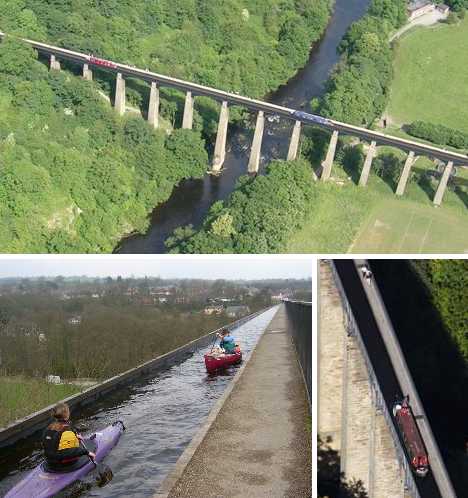
Engineer Thomas Telford designed the Pontcysyllte Aqueduct in Wales.It is the longest and highest aqueduct in Britan at 1,007 ft (307 m) long, 11 ft (3.4 m) wide and 5.25 ft (1.60 m) deep, it carries the Llangollen Canal over the River Dee in Wrexham, northeast Wales.
The Pontcysyllte (pronounced “pont-ker-suth-tee”) Aqueduct may have been the height -literally – of technology at the time, but its construction involved some surprisingly unusual and ancient techniques. One example is the mortar used to cement the masonry piers: it was made from water, lime, and ox blood!
It is often the Pontcysyllte Aqueduct in TV programs and tourist publicity shots. It was added to theUNESCO World Heritage List in 2009. The aqueduct is used regularly by pleasure boats and commercial “narrowboats”, and once every 5 years it’s drained (by removing a plug) for cleaning and routine maintenance.
More aqueducts at - you guessed it WebUrbanist's "Slippery When Wet: The UK’s Top 10 Navigable Aqueducts"
The Lune Aqueduct (above) supports the Lancaster Canal and towpath over the River Lune in Lancaster, England. Designed by John Rennie following classical architectural techniques, the 19 meters (62 ft) aqueduct over the River Lune is supported by 5 arched brick piers. It was built between 1794 and 1796, and its cost ran way over budget preventing the Lancaster Canal from connecting to the main canal network via the never-built aqueduct over the Ribble river. The Lune Aqueduct not only looks Roman, it was built using Roman technology adapted by Rennie, to ensure the stone bed of the aqueduct would not leak, Rennie specified the use of Pozzolana powder, a Roman invention that allows concrete to set underwater. The Lune Aqueduct is still in use today.
![]() |
| Avon Aqueduct |
At 250 meters (810 ft) long and 26 meters (86 ft) high, the Avon Aqueduct is Scotland’s longest and tallest aqueduct. Built after a design by navigable aqueduct pioneer Thomas Telford, the Avon Aqueduct features a cast iron trough supported by 12 brick and masonry arches.
The aqueduct runs through Muiravonside Country Park, providing a spectacular scenic view from the park’s lush landscape or from the top of the aqueduct itself.
The Avon Aqueduct carried the Union Canal and is located near Linlithgow in West Lothian, Scotland. Three great navigable aqueducts facilitated water traffic on the Union Canal, which opened in 1822 and was closed in 1965, with the Avon Aqueduct being the largest and longest of the three.
![]() |
| Pontcysyllte Aqueduct |
Engineer Thomas Telford designed the Pontcysyllte Aqueduct in Wales.It is the longest and highest aqueduct in Britan at 1,007 ft (307 m) long, 11 ft (3.4 m) wide and 5.25 ft (1.60 m) deep, it carries the Llangollen Canal over the River Dee in Wrexham, northeast Wales.
The Pontcysyllte (pronounced “pont-ker-suth-tee”) Aqueduct may have been the height -literally – of technology at the time, but its construction involved some surprisingly unusual and ancient techniques. One example is the mortar used to cement the masonry piers: it was made from water, lime, and ox blood!
It is often the Pontcysyllte Aqueduct in TV programs and tourist publicity shots. It was added to theUNESCO World Heritage List in 2009. The aqueduct is used regularly by pleasure boats and commercial “narrowboats”, and once every 5 years it’s drained (by removing a plug) for cleaning and routine maintenance.
More aqueducts at - you guessed it WebUrbanist's "Slippery When Wet: The UK’s Top 10 Navigable Aqueducts"
Saturday, 3 September 2011
Blogging
Blogger has re-designed the look of this blog's design interface, so as well as working out where they'd placed some of the features, I thought I'd take a look at the Statistics page that pertains to this Blog.
And wow I knew Big Brother was out there collecting info on us all, but what I can retrieve was more than I'd imagined.
For example
And wow I knew Big Brother was out there collecting info on us all, but what I can retrieve was more than I'd imagined.
For example
- There have been 20,959 pageviews of the blog (an extra 3 just while I was browsing).
- The most popular Post (and third most popular) were on Shipwrecks. The second was on Street Art.
- Most everyone is searching on the ubiquitous Google, and looking for images at that.
- And the majority are coming from the U.S. (check out the map)
So to everyone out there - Thank you
Subscribe to:
Posts (Atom)