I've just finished listening to (as opposed to reading) Alex Scarrow's Last light and Afterlight, and I'm scared.
These books are fiction, but I started Last light when the English riots in August were happening (the looting, the arson, the loss of control by the police), were in fact paralleling the book, hence my apprehension & fascination with pilchards in tomato sauce.
The story was recommended to me as another in the post-apocalyptic theme. It takes a relatively common gist, our reliance on oil, but takes the premise up a notch.
I'm not that keen with how some of the deaths come to pass, or a generation-encompassing conspiracy, but the scenarios as the publicity states - is as real as tomorrow, and how long would you last.
Not wishing to ruin the story for others, but essentially it primarily follows the members of the Sutherland family after a massive oil crisis - what happens to them and to the rest of the world at large.
All I know is I'm stocking up the pantry with non-perishables!
Be prepared.
Saturday, 29 October 2011
Thursday, 13 October 2011
In the Shed
| The interior of the Stick Shed |
The Murtoa Stick Shed spans the length of five Olympic swimming
pools. Built in 1941, it is the last remaining of the sheds constructed in Australia as
a solution for grain storage during the World War II wheat glut. The Stick Shed demonstrates Australian ingenuity
during a time of hardship, some of the purlins and rafters were connected with twitched wire - the farmers' answer for holding things together.
Unfortunately the Stick Shed was only open to the public on the Big Weekend, work is underway to enable more frequent Open Days, but nothing has been announced yet - watch this space.
Sunday, 25 September 2011
Marmalake
Yesterday was an important date - it was the 70th anniversary of the Marmalake Grain Store. More commonly known as the Murtoa Stick Shed, construction began on 26th September 1941. Amazingly the shed was ready for its first shipment in just 4 months - January 1942. At a time when much of the building was done with little mechanical aid, and most of the workforce were away fighting overseas it is a wonderful achievement.
The shed comprised 56 rows of 10 poles to support a roof 19metres at the ridge and 270metres long by 60 metres wide. When full (by June that year) it held 3,381,600 bushels of wheat. And even more amazing there had been a 7 million bushel shed alongside this one, unfortunately it was demolished back in 1975.
The Stick Shed has been in the news lately as
![]() |
| Builders photo |
| ABC TV filming in the Shed on Friday |
- work on the restoration nears completion
- the Shed will be open to the public on Sunday 2nd as part of the Murtoa Big Weekend
Sunday, 4 September 2011
Rivers of time
Navigable aqueducts
played an important role in getting Great Britain’s industrial
revolution off the ground. In an age when railroads and commercial
highways had yet to be invented, these elevated artificial water bridges proved their worth at the time and have continued to do so for over two hundred years.
The Lune Aqueduct (above) supports the Lancaster Canal and towpath over the River Lune in Lancaster, England. Designed by John Rennie following classical architectural techniques, the 19 meters (62 ft) aqueduct over the River Lune is supported by 5 arched brick piers. It was built between 1794 and 1796, and its cost ran way over budget preventing the Lancaster Canal from connecting to the main canal network via the never-built aqueduct over the Ribble river. The Lune Aqueduct not only looks Roman, it was built using Roman technology adapted by Rennie, to ensure the stone bed of the aqueduct would not leak, Rennie specified the use of Pozzolana powder, a Roman invention that allows concrete to set underwater. The Lune Aqueduct is still in use today.
At 250 meters (810 ft) long and 26 meters (86 ft) high, the Avon Aqueduct is Scotland’s longest and tallest aqueduct. Built after a design by navigable aqueduct pioneer Thomas Telford, the Avon Aqueduct features a cast iron trough supported by 12 brick and masonry arches.
The aqueduct runs through Muiravonside Country Park, providing a spectacular scenic view from the park’s lush landscape or from the top of the aqueduct itself.
The Avon Aqueduct carried the Union Canal and is located near Linlithgow in West Lothian, Scotland. Three great navigable aqueducts facilitated water traffic on the Union Canal, which opened in 1822 and was closed in 1965, with the Avon Aqueduct being the largest and longest of the three.
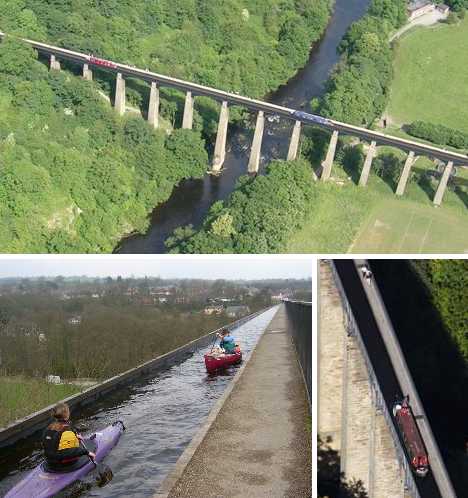
Engineer Thomas Telford designed the Pontcysyllte Aqueduct in Wales.It is the longest and highest aqueduct in Britan at 1,007 ft (307 m) long, 11 ft (3.4 m) wide and 5.25 ft (1.60 m) deep, it carries the Llangollen Canal over the River Dee in Wrexham, northeast Wales.
The Pontcysyllte (pronounced “pont-ker-suth-tee”) Aqueduct may have been the height -literally – of technology at the time, but its construction involved some surprisingly unusual and ancient techniques. One example is the mortar used to cement the masonry piers: it was made from water, lime, and ox blood!
It is often the Pontcysyllte Aqueduct in TV programs and tourist publicity shots. It was added to theUNESCO World Heritage List in 2009. The aqueduct is used regularly by pleasure boats and commercial “narrowboats”, and once every 5 years it’s drained (by removing a plug) for cleaning and routine maintenance.
More aqueducts at - you guessed it WebUrbanist's "Slippery When Wet: The UK’s Top 10 Navigable Aqueducts"
The Lune Aqueduct (above) supports the Lancaster Canal and towpath over the River Lune in Lancaster, England. Designed by John Rennie following classical architectural techniques, the 19 meters (62 ft) aqueduct over the River Lune is supported by 5 arched brick piers. It was built between 1794 and 1796, and its cost ran way over budget preventing the Lancaster Canal from connecting to the main canal network via the never-built aqueduct over the Ribble river. The Lune Aqueduct not only looks Roman, it was built using Roman technology adapted by Rennie, to ensure the stone bed of the aqueduct would not leak, Rennie specified the use of Pozzolana powder, a Roman invention that allows concrete to set underwater. The Lune Aqueduct is still in use today.
![]() |
| Avon Aqueduct |
At 250 meters (810 ft) long and 26 meters (86 ft) high, the Avon Aqueduct is Scotland’s longest and tallest aqueduct. Built after a design by navigable aqueduct pioneer Thomas Telford, the Avon Aqueduct features a cast iron trough supported by 12 brick and masonry arches.
The aqueduct runs through Muiravonside Country Park, providing a spectacular scenic view from the park’s lush landscape or from the top of the aqueduct itself.
The Avon Aqueduct carried the Union Canal and is located near Linlithgow in West Lothian, Scotland. Three great navigable aqueducts facilitated water traffic on the Union Canal, which opened in 1822 and was closed in 1965, with the Avon Aqueduct being the largest and longest of the three.
![]() |
| Pontcysyllte Aqueduct |
Engineer Thomas Telford designed the Pontcysyllte Aqueduct in Wales.It is the longest and highest aqueduct in Britan at 1,007 ft (307 m) long, 11 ft (3.4 m) wide and 5.25 ft (1.60 m) deep, it carries the Llangollen Canal over the River Dee in Wrexham, northeast Wales.
The Pontcysyllte (pronounced “pont-ker-suth-tee”) Aqueduct may have been the height -literally – of technology at the time, but its construction involved some surprisingly unusual and ancient techniques. One example is the mortar used to cement the masonry piers: it was made from water, lime, and ox blood!
It is often the Pontcysyllte Aqueduct in TV programs and tourist publicity shots. It was added to theUNESCO World Heritage List in 2009. The aqueduct is used regularly by pleasure boats and commercial “narrowboats”, and once every 5 years it’s drained (by removing a plug) for cleaning and routine maintenance.
More aqueducts at - you guessed it WebUrbanist's "Slippery When Wet: The UK’s Top 10 Navigable Aqueducts"

Saturday, 3 September 2011
Blogging
Blogger has re-designed the look of this blog's design interface, so as well as working out where they'd placed some of the features, I thought I'd take a look at the Statistics page that pertains to this Blog.
And wow I knew Big Brother was out there collecting info on us all, but what I can retrieve was more than I'd imagined.
For example
And wow I knew Big Brother was out there collecting info on us all, but what I can retrieve was more than I'd imagined.
For example
- There have been 20,959 pageviews of the blog (an extra 3 just while I was browsing).
- The most popular Post (and third most popular) were on Shipwrecks. The second was on Street Art.
- Most everyone is searching on the ubiquitous Google, and looking for images at that.
- And the majority are coming from the U.S. (check out the map)
So to everyone out there - Thank you
Sunday, 28 August 2011
Eyes wide open
I watched 'The War You Don't See' on the weekend, and I'm still thinking about it, questioning.
As John Pilger's site says "It is a powerful and timely investigation into the media's role in war, tracing the history of 'embedded' and independent reporting from the carnage of World War One to the destruction of Hiroshima, and from the invasion of Vietnam to the current war in Afghanistan and disaster in Iraq. As weapons and propaganda become even more sophisticated, the nature of war is developing into an 'electronic battlefield' in which journalists play a key role, and civilians are the victims."
One of the best quotes was "investigative journalists are the biggest threats to a nation's security".
Thursday, 25 August 2011
The art of the library
Sometimes I find it regrettable that Australia does not have centuries old buildings - castles, monasteries...libraries. While there are still beautiful Georgian buildings dating from late 18th century there isn't the art and the history.
Still there is Bountiful Books: 13 Incredibly Intricate Historic Libraries: Dark wood, dazzling details, leaded glass windows and tier after towering tier of books – classic historic libraries are a bibliophile’s dream. These libraries, dating from the 18th to the early 20th centuries, represent some of the most astonishingly beautiful book repositories ever built.
Trinity College Library, Dublin, Ireland
At Ireland’s oldest university Trinity College, home to the "Book of Kells", the ‘Old Library’ with its Long Room >> stuns with its dark wood, spiral staircases and seemingly endless aisles of books.
It was built between 1712 and 1732 and renovated in 1860 to include a barrel ceiling for a second floor of book shelves.
The largest library in Ireland, it has 5 million printed volumes with extensive collections of journals, manuscripts, maps and music.
Iowa State Capitol Law Library
Hogwarts immediately comes to mind with these photos.
A lacy white banister flows along tier after tier of books and down a beautiful spiral staircase at the Iowa State Capitol Law Library, located in the Capitol building.
The library provides Iowa lawmakers, lawyers, government employees and the public with a specialised legal collection of treatises and law books.
More libraries are featured at WebUrbanist
Monday, 22 August 2011
Monday, 1 August 2011
Subscribe to:
Posts (Atom)