Thursday, 11 December 2008

#29 Scrapblog

Scrapblog as the name suggests is a form of online scrapbooking. Again, I've played with scrapblog previously, and found some aspects really good and some a bit annoying (especially all the email notifications).

This time the exercise required that we create a scrapblog with the images representing our favorite books (gathered in Thing 27 - Photobucket) and integrate a few of the effects, then publish it and share it on flickr.
You can see my pages below or go to flickr and find it tagged: mccaffrey, harryp and scrapblogbooks (all participants use this tag).


For those without access to programs such as Photoshop, Scrapbook lets you use its features to be creative with your photos, or from other photo-sharing sites to have a play and combine them with fancy frames, stylish stickers, brilliant backgrounds, etc. Flyers and notices will never be the same again.

Tuesday, 9 December 2008

Faithfully abandoned

It's a while, since I've 'Abandoned' anything, so now at this time of yuletide, are some abandoned churches. Nowdays old churches are being converted into private homes, quaint B&Bs, and pizza restaurants, but some have just been left alone after the last congregation left.
For some like the Kalkee Methodist Church, only a few bricks and the entrance remain at the site.

The first Wesleyan church of sun dried bricks was established in 1876 one km north of the present site. In 1885 a new wooden church was completed, this was severely damaged by white ants and the dust storms of the 1902 Federation drought. A new church on the present site opened in 1905, it closed on 17.8.1975 and the building was sold for removal.

The church in 1974

Ebenezeer Church

Ebenezeer Mission Station was first established in 1859 by the Moravian Church, for the Aborigines of the area. The Mission was located on the banks of the Wimmera River, south of Lake Hindmarsh, near the town of Antwerp.


The missionaries opened a school for the Aborigines, hoping to educate the Aborigines to read and also to ‘civilise’ them into European ways. The Aborigines on the station were involved in the building of the stone and wood cottages, as well as hunting, fishing and farming for the men and domestic duties for the women. The mission was successful and a model for other missions in Victoria.

The mission closed in 1904 after the last missionary had died in 1903, and due to the government's assimilation policy which only allowed full-blooded Aborigines to live on the stations. The land was divided up and sold for farming, except for a small section on which the buildings still remain. These are the oldest surviving mission buildings in Victoria, and have been stabilised and partly restored. The historic station property is now jointly operated by the National Trust and the Goolum Goolum Aboriginal Co-operative.
Rev. Kramer's grave

Thursday, 4 December 2008

#28 Magazine image generators

This exercise stated "I don’t know how many of you recognize these lyrics from Dr. Hook’s 1973 hit, On the Cover of the Rolling Stone. But if you've ever dreamed about being featured on a magazine cover, these image generators will give you that chance."

We had to create a cover and post it to our blog, so here are a couple for when some multi-national coffee-table type magazine executive commissions me to tour the world on photo shots of exotic locations.


And yes I remember "On the cover of the Rolling Stone" by Dr Hook. Interestingly the Web2.1 link to the song is no longer available, here is my link.

Monday, 1 December 2008

#27 Photobucket

I trialled photobucket nearly a year ago (post of 8th December 2007), as it allowed for bulk uploads of photos. It has grown in leaps and bounds since then. I searched for favorite books/authors, and used the Find stuff to browse and added them to My album.
Like flickr there seems to be a level of duplication and some average photos loaded, but I did like this illustration below (depicting Anne McCaffrey's book "Lyon's pride").

Thursday, 27 November 2008

#26 Widgets

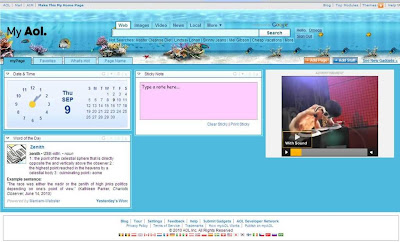
This lesson is on widgets the little gadgets that allow or open often used programs on your desktop eg little calendars, weather forecast info. This lesson features "yourminis", but in October 2008, "yourminis" decided to no longer support their startpage., making the Discovery Exercise obsolete, so I went to myAOL and iGoogle to check out their Startpage, and played with creating a page with widgets at myAOL.

I created a page and added a Word of the Day, Calendar and Clock widgets. I'm still to see if I can change colours and remove the adverts.

Thursday, 20 November 2008

#25 LetterPop

LetterPop is a collection of templates for newsletters, etc. that allows you to add your own headings and text, and photos - either from your own files or flickr. This is the free version but for serious users there's an increasing scale allowing more issues and more recipients.
While there's about 170 templates to choose from, I'd like a bit more chance to move the elements around, enlarge or decrease some. However for people who just want to produce a regular, similarly styled newsletter quickly to email to a selected list, this would be great.
My page is at
http://letterpop.com/newsletters/?id=104495-247145

Tuesday, 18 November 2008

#24 Explore.Discover.Play

Having finished my study for the year, I can now devote some time to "Learning 2.1" which is the follow-up to "Learning 2.0 - 23 things", which prompted this blog in the first place.

Learning 2.1's motto is explore...discover...play, it now has 37 things (I should have done this when I first checked as they've added 13 more things since!) or web 2.0 technologies to learn about.

The first is "Zamar" a free file conversion service. I really needed this last week when I had to convert a word file to pdf, and I like the idea of trialling converting YouTube videos to moving picture experts group file, useful for including video in PowerPoint presentations when you don't have access to the Internet, or as a Plan B if the connection won't work.


This Chaser file still looks a lot like an embedded YouTube file, but I can incorporate it in more applications.

Saturday, 1 November 2008

Serviceton Railway


The town of Serviceton (named after former Victorian Premier - Sir James Service) was gazetted on 1st January 1887. In the early years in had general stores, bakery, butcher, blacksmith, boarding houses and livery stables, temperance hotel, coffee palace and wine bar.


It became a major border crossing and an important customs station for goods passing between the colonies of South Australia and Victoria.


A Late Victorian railway station was built in 1887 of red bricks transported from Horsham. The building opened in 1889.


From the front, it had a central two storey symmetrical neo-Classical polychromatic brick station building accommodating former residential functions with flanking office wings.


The ground floor level consists of 15 main rooms, and accommodated toilets, waiting rooms, dining and sitting room, bar and kitchen, offices, lobby and customs office.


The Refreshment Room is 52 feet long with high ceilings, it is still used today for functions.


Upstairs Refreshment Manager's Bedroom

The extensive underground storage and service area was equipped with a mortuary for bodies being shipped across the border and there is a dungeon lock-up furnished with iron rings fastened to the walls, which was used for criminals captured in the disputed area or to be held over until the next train and prisoners who were being transported interstate.


The Cellar


The enormous 70-metre platform with cast iron posted verandah of standard design faces the running lines and is the largest example of its type, the platform was the longest in the State, until a portion was removed in the late 1980s.


The outbuilding/staff hostel, van goods shed, lamp room signal box goods shed and platform have all been removed.
There were two engine sheds but, with the lack of local water, the original water reservoir for the trains was constructed astride the boundary line.


The Guards Rooms

The customs office set up shop in the railway station to ensure duty was paid for goods taken interstate but the law was difficult to enforce as the town was in the 'Disputed Territory', a strip of land 4.5 km in width which stretched along the length of the state border.

The station was closed in 1986.

The Customs Store Rooms

Thursday, 30 October 2008

Arapiles


"Arapiles : selected climbs" by Simon Mentz and Glenn Tempest

The new second edition of “Selected climbs” makes the best use of publishing's capabilities.
It has natural colour photographs, many with the routes superimposed on top. The fold-out front cover has a panoramic landscape view of Arapiles and Mitre Rock and has the names the major peaks and cliffs below.
There's chapter on the history of rockclimbing at the Mount, with bios and photos of some of the pioneer climbers who have lived in Nati, or stayed at the Pines camping ground.
In total there are 1,200 selected climbs, 154 colour topos, grading and descriptions of the climbs, belay points, sun/shade icons for when in the day to go or avoid .